Our Context Platform keeps your context layer accurate as the business changes. It connects to the AI assistants you already use, flags what has gone out of date, and lets your people approve each update
Everyone has access to AI. Context turns it into advantage
How it works
A single source of truth that powers every agent run
Encode your proprietary knowledge
We gather context from where it already lives: your systems, your documents, and the people who do the work. Your proprietary knowledge remains yours and is your advantage
Systems
Documents
Policies MSA
People
SR JB AK
32 interviews
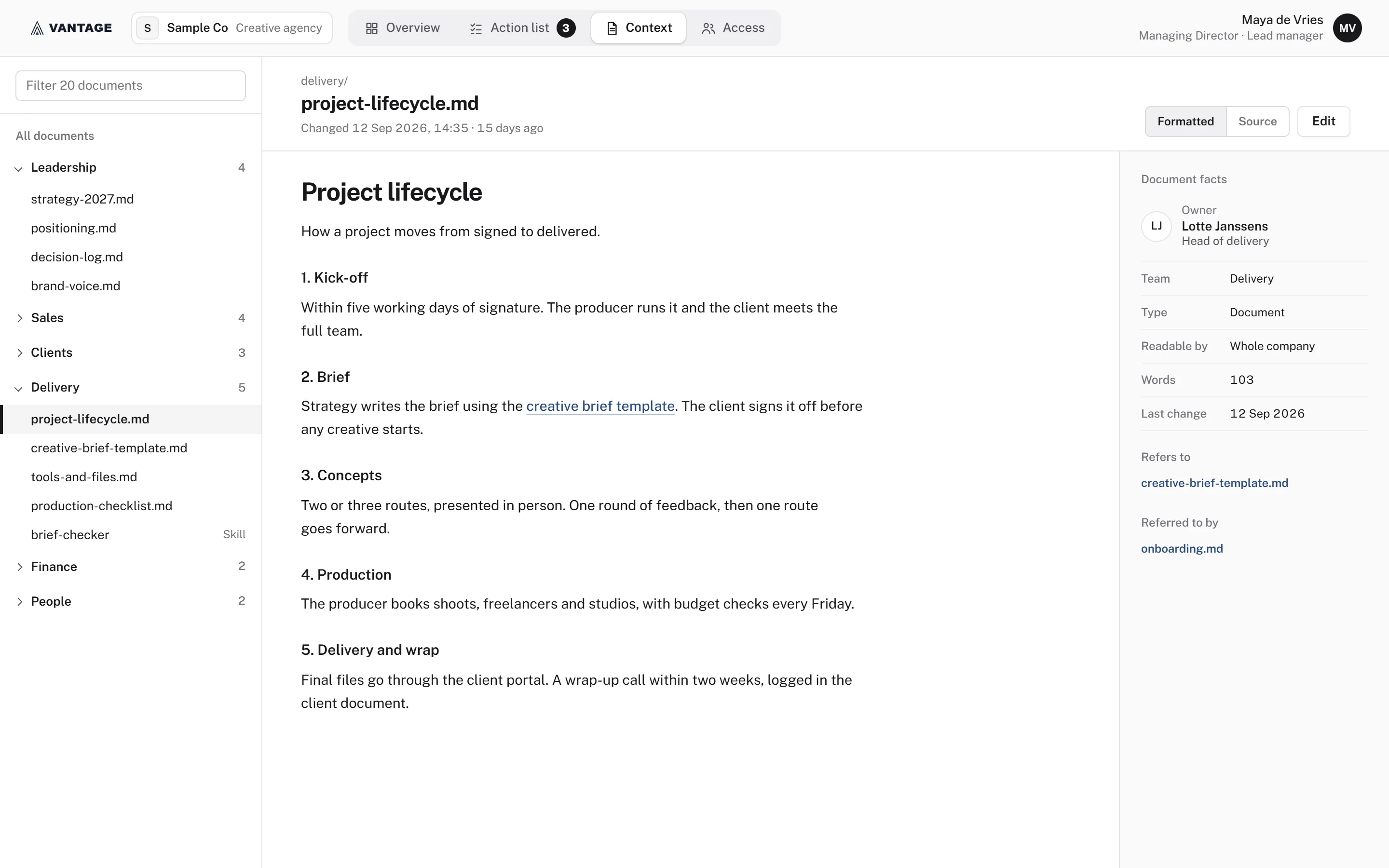
Context layer
Your company · 78 files
customers/
processes/
quote-to-cash.md
policies/
decision-rights/
roles/
glossary/
brand/
Keep it current as the business changes
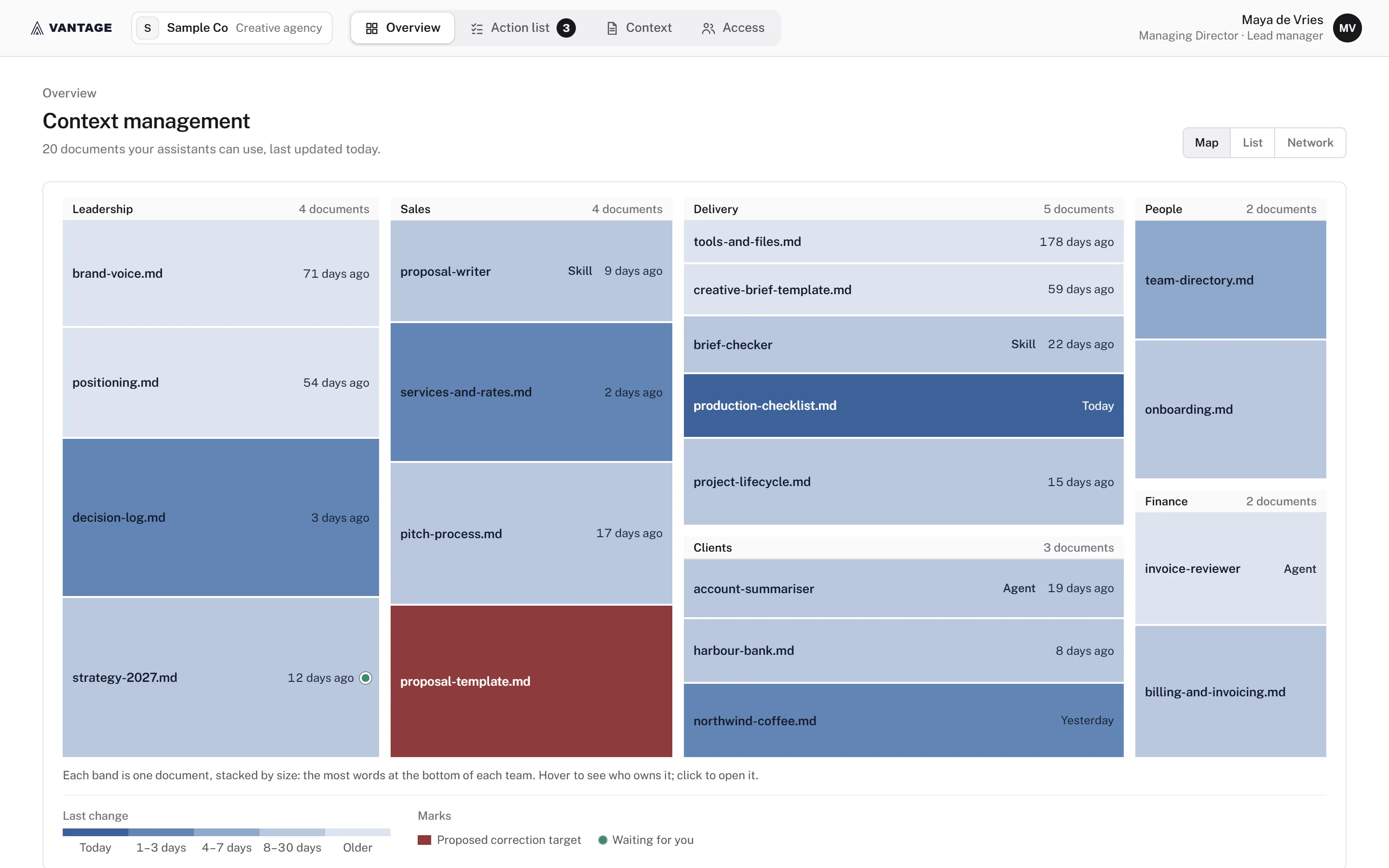
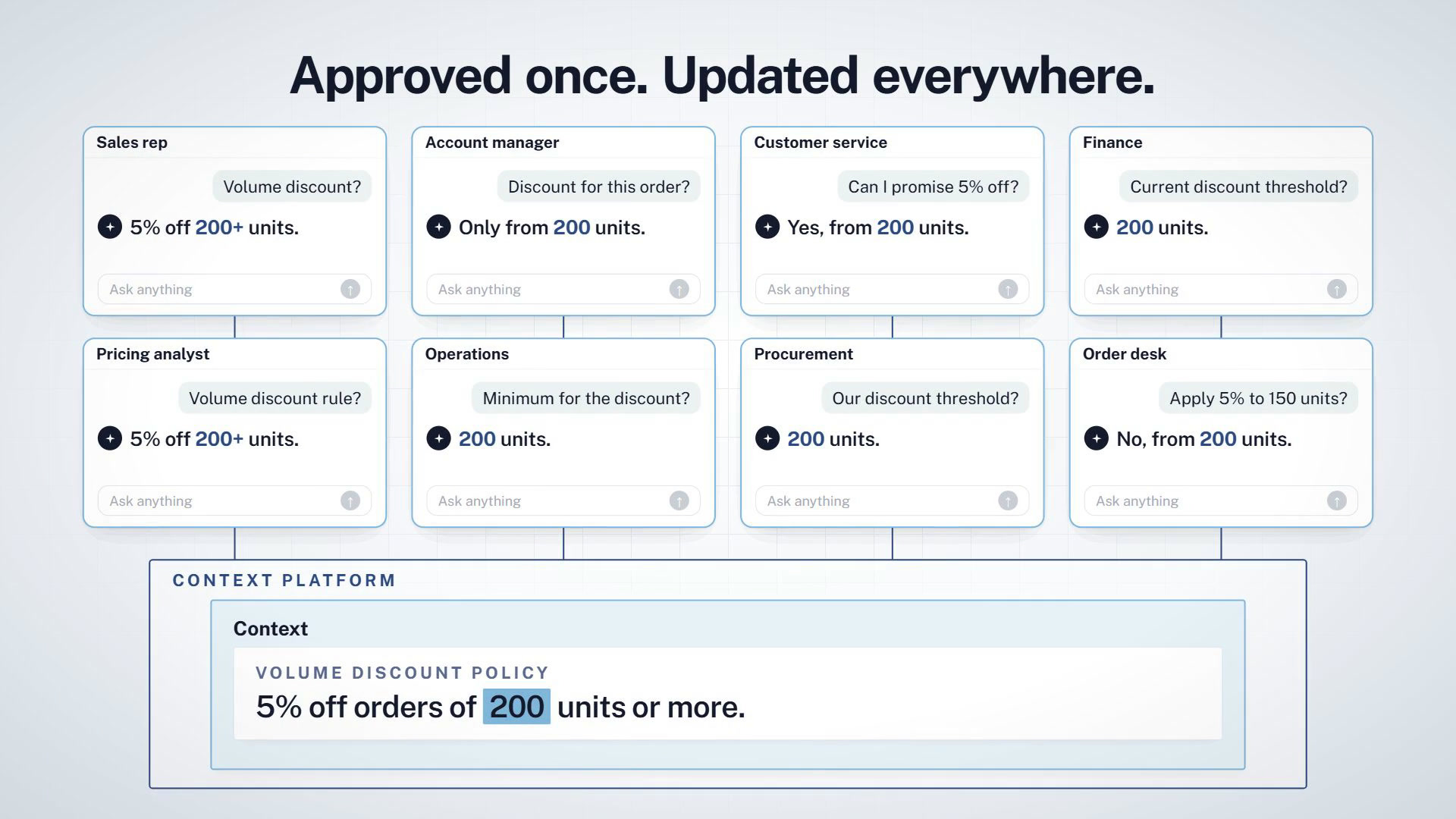
Context set once goes stale fast. Agents watch the sources and propose updates; your people accept or reject them. Every change is versioned, so you can see what moved
Context layer
Your company · 78 files
customers/
processes/
policies/
invoicing.md
Out of date
decision-rights/
roles/
glossary/
brand/
Email from FinanceNew standard payment terms
Proposed update
All customers: 30 days
All customers: 45 days from 1 Nov
AKAcceptReject
Make it readable by every model and agent
One repository that AI requests draw on, grounding AI in your company’s context. Permissions ensure that the agent can see only what the person is allowed to reach
Claude “Prep a brief for tomorrow’s Northwind call.”
ChatGPT “Draft the follow-up after today’s demo.”
Copilot “Update the deal notes from this morning.”
A 77-second film without sound. An AI assistant guesses without company context. The Context Platform captures how the company works, drafts an update when a policy changes, and once a person approves it, every team’s assistant gives the same answer.
Context Platform
The foundation that grounds agents into your company context
01
Model routing
Any model from any provider runs through the platform. Swap models anytime and your context & controls stay put
02
Tailored context
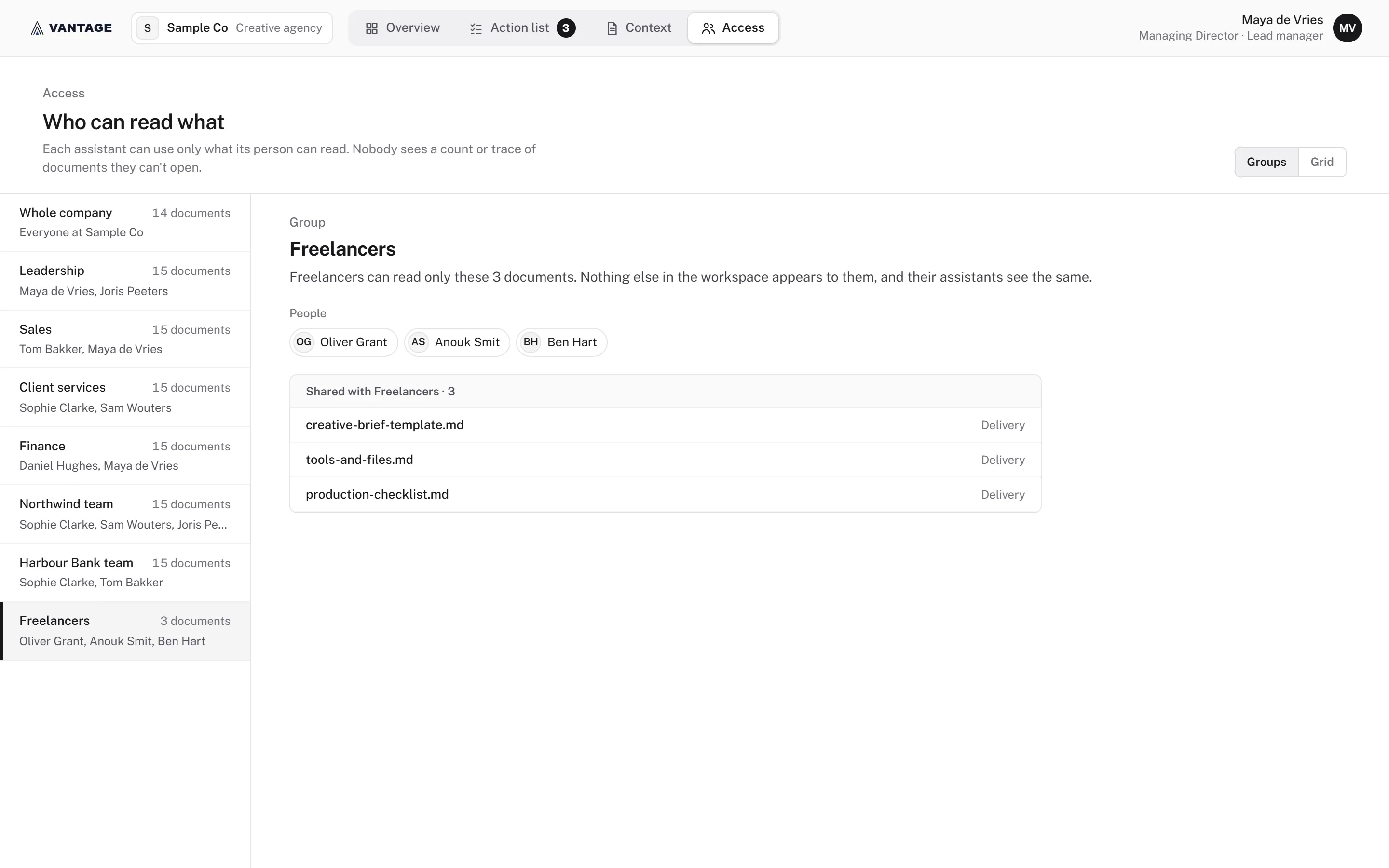
Context is set at company-wide, team, and individual levels. Every agent only accesses what the job needs
03
Connected to existing systems
The layer reads from the systems you already run, over API, MCP, or CLI. No months-long data foundation programme before you start
04
Kept up to date
Context agents draft updates as your sources change, and your people approve them. The upkeep is automated; the judgement stays with you
05
Controls & permissions
Access and permissions govern what every agent can read and do. One governed layer avoids agent & skill proliferation
06
No lock-in
The context structure is yours, exportable at any point in a form that works outside our tooling
Company-specific AI assistants and agents
Context Platform
Proprietary context Company Team Personal
Knowledge bases
–
Memory
–
Business rules
–
Connections
–
Governance and controls
Frontier Open-weight Specialist
AI model Intelligence & public information
What it unlocks
Faster decision-making and information retrieval at organisational scale
The first use case the context layer unlocks is the ability to find & share critical business information across teams in seconds
Business function · Illustrative
Less time gathering context, more time in front of customers
Every outbound email written with the full account history behind it
Deal context carried through every handover, not rebuilt from scratch
Call summaries that come out in one structure, every time
Less time reconstructing past decisions, more time building
Coding agents that know the intent behind the codebase, not only its files
Architecture decisions and their reasons available at the point of work
Faster answers, drawn from current policy every time
Answers drawn from current policy rather than last year’s document
An agent that knows what this customer has already been told
New joiners productive sooner, with fewer repeat questions
Role-specific onboarding packs assembled from what the role actually needs
An employee helpdesk that knows the real policy, including the exceptions
One voice across every channel, without rewriting every draft
Campaign and launch briefs built from current company context
Every agent writing in one voice, because the voice is defined once
One set of approved wording for the things the firm says often
Answers from one source, and policy applied every time
RFP and security questionnaires answered from a single source
Procedures held centrally rather than in a folder per team
Policy checks an agent cannot skip, because they sit in the layer
Less time searching, more time deciding
Meeting briefs prepared with the context the meeting actually needs
Finding who holds the relevant expertise, without asking around
A trace of what every agent read and what it changed
What a central context layer unlocks
One repository of skills
Prompts, agents, and methods live in one place, so an improvement by one team reaches everyone
One tone of voice, set centrally
How the firm writes is defined once and read by every agent, so the voice holds in every team
Every change on record
Each update is versioned with who approved it and when, so you can always see what changed and why
Permission-aware retrieval
An agent reaches only what the person behind it may reach, because permissions live in the layer
Frequently asked questions
Questions and answers
/01 Is this a data warehouse or a knowledge management project?
No. A data warehouse centralises data for reporting and analysis, and a knowledge management programme asks your people to write and maintain documents. The context layer carries what AI needs in order to work in your business: how the business runs, what your policies allow, who may see what, and where your data lives
It connects to your existing systems rather than requiring a separate data programme first. Capture builds it across the organisation, team by team and workflow by workflow, and Compound keeps it current from there. If a use case needs data copied, indexed, or transformed, or depends on data your systems cannot provide, we say so plainly before anything is built
/02 Do we need to run Capture first?
Usually, yes. Most of what makes a business run is never written down, and Capture is how it gets into the context layer: we draw on your documents and systems and interview your teams, from leadership to the front line. If your business is already well documented, we can build the layer from what you have and use Capture only where there are gaps
/03 How is this different from pointing an AI tool at our shared drive?
A shared drive holds documents; it does not hold how your business works. Search over it returns whatever matches the words, including the superseded version, the draft, and the one department’s local variation. A context layer is structured, versioned, and permission-aware: it knows which version is current, what relates to what, who may read it, and what an agent has already been told. That structure is the difference between an assistant that sounds plausible and one you would let act
/04 We already use Microsoft Copilot. Why do we need this?
Copilot and tools like it can only work from what has been written down somewhere they can reach. Much of what makes your business run never has been: it sits in people’s heads, in other systems, and in decisions nobody recorded. Capture writes it down, and Compound keeps it current, with your people approving every change. The context layer is built to be read by any model or agent, so it adds to the tools you already have rather than replacing them
/05 Who can see what?
Access controls and user permissions decide what each system and each person can reach, and permissions travel with the request, so an agent reaches only what the person behind it may reach. We agree these boundaries with your technology, data, and security owners during design, and document them before anything is switched on
/06 Does this tie us to one model provider?
No, and it is built specifically to prevent that. Models are selected per use case on quality, cost, and privacy, and routed accordingly. When a model is replaced, it is tested before real use, and your business context, connections, and controls are untouched by the change
/07 What can we take with us if we stop working with you?
Your context. You can export the whole context layer at any time, in a form that is useful outside our tools, and it is built so your own team can understand it. Nothing here is designed to make leaving expensive




 Context layer
 Context Platform